Inflation, remained in negative territory for the 7th month in May

The core infrastructure industries had expanded by 5.2 per cent in the previous month.

Buoyant manufacturing sector has pushed up industrial growth to 13.6 per cent in the first month of the current financial year against 9.9 per cent in April.

India's industrial output grew a better-than-expected 6.4 per cent in August compared with a downwardly revised 4.1 per cent growth a month ago.
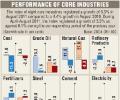
Eight infrastructure industries grew by 3.5 per cent in August this year, down from 4.4 per cent expansion witnessed in the same month last year.

The growth is particularly remarkable because it comes at levels higher than during the pre-Covid times, notes Mahesh Vyas.

'If the US stagnates and falls into a recession, the dollar will weaken, oil prices will also dip. This augurs well for India.'
India's industrial output unexpectedly rose 1.2 per cent in May from a year earlier, led by a pick up in manufacturing, government data showed on Tuesday.
As per data released by the government on Monday, industrial output grew by 3.5 per cent in the April-October period this fiscal, as against 8.7 per cent in the same period last year.

In comparison, industry grew by 2.1 per cent in May last year.
The previous low was recorded at 3.8 per cent in May this year.

'In the past six months, capital markets have seen a dip, and realty is struggling. The stock-market investor will be cautious of putting that investment in real estate when there may be a slowdown coming.'

For the entire 2015-16 fiscal, the factory output grew at 2.4 per cent, down from 2.8 per cent in the previous fiscal.
Indian Industry grew by 8.3 per cent in January this year compared to 7.5 per cent a year ago mainly due to the higher growth in manufacturing.
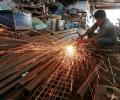
Despite high headline numbers, the output of one-third of the segments in the manufacturing sector in August stood below even that in the same month in 2011-12, when the new index of industrial production (IIP) series started. This is despite the fact that manufacturing grew 9.3 per cent in the month, driving up IIP growth to a 14-month high of 10.3 per cent. Part of it is due to the devastation of these product categories by lockdowns induced by Covid waves and subdued export conditions, while part of it needs to be assessed further.

Industrial growth, as measured by the index of industrial production, however, was slightly lower than around 16 per cent of the previous month and 17.6 per cent in December.
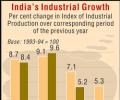
The Indian industry logged 8.5 per cent growth in October 2005, compared to 10.6 per cent in the same month last fiscal.

The growth of eight key infrastructure sectors rose to a 14-month high of 12.1 per cent in August 2023 against 4.2 per cent a year ago, mainly due to expansion in production of coal, crude oil, and natural gas, according to the official data released on Friday. The expansion in August is the highest since June 2022, when it was 13.2 per cent. The production of refinery products, steel, cement and electricity also grew in August, the data showed.

Factory output in March, as measured in terms of the Index of Industrial Production released today, also witnessed lower growth of 7.3 per cent, compared to 15.5 per cent expansion in the same month a year ago.
Led by a strong recovery in the manufacturing sector, the industry registered an impressive growth of 7.9% during August 2004 against 5.7% in the same month last year.
The fiscal 2008-09 began on somber note with industrial growth in April dropping to 7 per cent compared to 11.3 per cent in the same month a year ago, reflecting the impact of higher interest rates and rising input costs.The performance in April, however, was much better than the 3.9 per cent growth rate witnessed during March, the last month of the previous fiscal, according the Index of Industrial Production (IIP) data released on Thursday.
However, growth in factory output in January, as measured in terms of the Index of Industrial Production, was better than the 2.53 per cent expansion (revised upward from 1.6 per cent) witnessed in the previous month.
India's industrial production shot up by 12.4 per cent in July 2006 as against 4.7 per cent in the same month last year.
The decline has been mainly on account of a fall in manufacturing, the output of which contracted by 3.3 per cent during March. The sector, which accounts for almost 80 per cent of the index, registered an increase of 5.7 per cent during the same month in 2008.

Industrial growth zoomed to 16.8 per cent in December 2009, giving hope to the government that overall economic growth may be faster and rekindling a debate on withdrawal of stimulus packages in the Union Budget.
The Index of Industrial Production recorded an impressive growth of 11 per cent in February despite power sector registering dismal performance indicating unpleasant summers in the days ahead.
An all round poor performance in the key sectors dragged down the industrial growth to 5.2 per cent in August this year as against 6.2 per cent in the same period in 2002-03.

If the index is unable to sustain above 24,500 levels, technically it can then slip to its 200-DMA placed at 23,365 levels.
Decline in production of crude oil coupled with a slowdown in output of other products pulled back the growth of six key infrastructure industries to 5.3 per cent in June compared to 7.7 per cent a year ago.
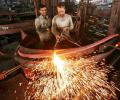
Economists surveyed by Reuters had forecast a 0.5 per cent growth in output

Wholesale price inflation rose to a 4-month high of 2.36 per cent in October as prices of food items, especially vegetables, and manufactured goods turned dearer, as per the government data released on Thursday. The wholesale price index (WPI) based inflation was 1.84 per cent in September 2024. It was (-) 0.26 per cent in October, last year.
Industrial growth in October 2003 increased to 5.4 per cent against the same month last year.

Brokerages expect a further slowdown in Indian firms' revenue and earnings growth in Q4FY25, following low single-digit growth in the preceding three quarters, as factors like weak consumer demand and credit growth linger on.
The country's industrial growth shot up to 14.4 per cent in November 2006, the fastest in more than a decade, on the back of impressive performance of manufacturing sector and a rebound in mining production.
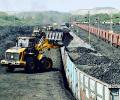
Production of eight infrastructure sectors increased by 5.4 per cent in November against a 3.2 per cent growth in the same month last year on a better show by coal, fertiliser, steel, cement and electricity segments, according to the official data released on Friday. Crude oil, natural gas and refinery products, however, recorded negative growth in November this year. The production growth of eight key sectors slowed down to 0.9 per cent in October.

The industrial production, which crossed 15 per cent in July, dipped to 6.91 per cent in August and further to 4.4 per cent in September.
The growth of eight key infrastructure sectors slowed down to a 4-month low of 8.1 per cent in September 2023 against 8.3 per cent a year ago, according to the official data released on Tuesday. The growth rate in the output of refinery products, fertiliser, cement and electricity during the month under review has decelerated, while it was negative in the case of crude oil. The previous low was in May, when the growth rate of these sectors stood at 5.2 per cent.

During the April-July period of this fiscal, IIP growth stood at 5.8 per cent, as against 9.7 per cent in the corresponding four-month period last year.

Industrial growth during the April-June quarter stood at 6.8 per cent.

In terms of industries, 10 out of 23 industry groups in the manufacturing sector showed positive growth during November 2018.
